Facility Hot Spots: Diagnose Airflow Before a Fan Retrofit
Key Highlights
- A fan can run normally and still leave a facility hot if loaded filters, restricted return paths, or duct resistance keep the air from reaching the heat source.
- Measure airflow, static pressure, fan speed, motor current, power draw, and supply and return air temperatures before committing to a retrofit.
- EC fans adjust speed to match changing heat loads, which cuts energy use during low-demand periods. Fan arrays add redundancy so one failure doesn't take out cooling.
- Axial fans suit high-volume, low-resistance applications, such as condensers and rooftop units. Centrifugal fans are the better fit for ducted systems with filters, coils, and other added resistance.
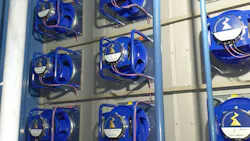
A facility that keeps running hot with the fans on doesn't necessarily need more fan. It needs an answer to one question: Is the system delivering the required airflow, at the required static pressure, to the spots where heat is building?
Loaded filters, a restricted return path, unexpected duct resistance, or a new cluster of heat-producing equipment can all leave a fan running normally while temperatures climb. As plants, data centers, and mechanical rooms add denser electronics and tighter layouts, more ventilation systems are working against heat loads they were never designed to handle. Adding capacity without diagnosing the air path can raise energy costs and leave the hot spot in place.
For facility managers, maintenance teams, and plant engineers weighing a fan retrofit, here's what to measure first, when variable-speed EC fans make sense, how to match axial or centrifugal fans to system resistance, and how to scope an upgrade that fixes the actual thermal problem.
Diagnosing Hot Spots: Airflow, Static Pressure, and Fan Curves
Persistent heat is often treated as a capacity problem, but the first diagnostic question is whether the delivered air is doing useful work. A fan may meet its selected operating point and still leave parts of the facility hot if the air path is poorly controlled. Supply air can return too quickly without sweeping the occupied or equipment dense zone. Heat can build in areas where circulation is weak. A restricted return path can also limit total system volume, leaving the fan with less air to move through the space than the design assumes.
Static pressure is where many of those problems become measurable. Ductwork, filters, coils, dampers, guards, and discharge conditions all add resistance to the airstream. As that resistance increases, the fan may shift away from the point on the curve where the system was originally designed to operate. Loaded filters are a common example: as pressure drop rises, the fan must work against a different system condition than it did when the filters were clean. If the fan cannot maintain the required airflow at that higher resistance, the space can continue to heat up even while the equipment appears to be running normally.
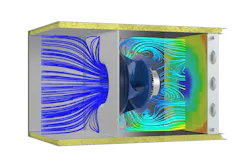
That is why facility teams need a measurement set before making retrofit decisions. Airflow and static pressure show whether the fan is delivering against the actual system resistance. Fan speed, motor current, and power consumption show how hard the equipment is working to do it. Supply and return air temperatures, along with temperature rise across the space, help determine whether the problem is fan performance, air distribution, or a heat load that has outgrown the original design assumptions.
The fan curve adds another layer to that review. Axial and centrifugal fans respond differently as resistance changes, so the operating point matters as much as the nameplate capacity. Axial fans are especially sensitive to operation in the stall region of the curve, where airflow can become unstable and turbulence can increase vibration, performance inconsistency, and mechanical stress on the motor and impeller. When a facility runs hot, raising fan speed may only treat the symptom. The stronger question is whether the fan is operating in a stable, efficient part of the curve for the system as it exists.
Constant-Speed vs. EC Fans for Temperature Control
Legacy constant-speed fan systems are usually designed around a single operating point. That can work when the heat load, airflow path, and pressure requirements remain stable, but they become less effective when equipment density changes, heat becomes concentrated in different locations, or the facility needs to respond to changing demand throughout the day.
A constant-speed fan has limited ability to follow those changes. It may waste energy during low demand periods while still lacking the control needed to respond when heat concentrates in a specific area. In many constant-speed systems, control comes from cycling the fan on and off or using dampers to restrict airflow. Both approaches can influence temperature, but neither allows the fan to continuously adjust its speed based on temperature, pressure, or airflow feedback.
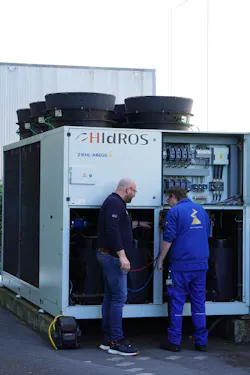
Variable-speed operation changes this relationship. Instead of forcing the fan system to run around one fixed condition, speed modulation allows the fan to respond to what the facility needs. When the heat load rises, fan speed can increase and when demand falls, fan speed can decrease. This gives the system a better chance of maintaining stable temperature while reducing unnecessary energy use.
Electronically commutated fans, commonly referred to as EC fans, integrate motor and control capability into a single high efficiency package. Unlike a traditional AC motor driven fan that may require an external variable frequency drive to adjust performance, an EC fan can speed up or slow down based on the control signal it receives from the system. That makes it useful in applications where temperature, pressure, or airflow requirements change over time.
The energy advantage comes from avoiding unnecessary full speed operation. A fan that only needs partial output should not have to run as if peak demand is always present. By matching speed more closely to the load, EC fan systems can support temperature stability while reducing power consumption. The same control capability can also simplify system response when sensors detect higher pressure drop, blocked airflow, or a heat load that has moved beyond the original design assumption.
Axial vs. Centrifugal Fans: Matching Fan Type to Static Pressure
Fan selection should be tied to the pressure and airflow requirements of the application, not only to the size of the facility or the general desire for more cooling. Those requirements determine whether the system needs a fan built primarily to move large volumes of air or one designed to push air through higher resistance. That distinction is where axial and centrifugal fans begin to separate.
Axial fans are strong choices when the application requires high air volume at relatively low static pressure. They are commonly used in applications such as condenser sections, rooftop equipment, and other systems where air is pulled through coils and discharged to the atmosphere. Their strength is moving a large volume of air efficiently when the resistance path is not overly complex.
Centrifugal fans are better suited to applications with higher resistance. Ductwork, filters, coils, turns, and more complex airflow paths all increase pressure requirements. In those systems, the fan must be able to push air through the resistance created by the installed components. Selecting an axial fan for an application that behaves like a high resistance system can leave the facility short on delivered airflow even if the fan appears large enough on paper.
Fan arrays add another design option, especially where redundancy matters. A single large fan can create a single point of failure. If that fan goes down, the facility may lose a major portion of its airflow and quickly develop temperature problems. An array of smaller fans can provide more flexibility because the system may continue operating at reduced capacity if one fan fails. In equipment dense environments, that redundancy can be important for uptime, process stability, and thermal protection.
Control is also easier to refine with an array. Multiple EC fans can be staged or modulated to match changing demand rather than forcing one large fan to serve every operating condition. This can improve both controllability and serviceability, particularly in retrofit projects where downtime, access, and available space affect the final design.
Fan Retrofit Planning: Define the Heat Problem First
New fans can improve performance, but they will not solve every overheating issue on their own. Before committing to a retrofit, facility teams should define the specific problem they are trying to correct. The most useful starting point is determining whether the issue is insufficient airflow, excessive static pressure, poor air distribution, inadequate control, rising heat load, or aging equipment that no longer operates as intended.
The same measurements used in diagnosis should guide the retrofit decision. Those values show whether the existing system is failing to deliver required performance or whether the facility’s requirements have changed. They also help determine whether a fan upgrade alone is enough or whether a specific variable needs attention.
EC fan technology can be a strong retrofit path when the facility needs better speed control, higher efficiency, simplified wiring, or improved redundancy. In many cases, the fan, motor, and control capability are integrated in a compact package, reducing some of the external components associated with AC motor and VFD arrangements. For facility teams working within downtime and budget constraints, that integration can make upgrades easier to plan and implement.
However, EC fans aren't the answer for every system. Large-horsepower applications still commonly rely on AC motors with VFDs, and upfront cost should be weighed against expected energy savings.
Supplier engineering support matters here. A retrofit should be scoped against the facility's resistance profile, control requirements, installation constraints, and long-term maintenance expectations, not treated as a one-for-one part swap. Replacements that look right on paper can still miss the underlying thermal problem.
Still, the value of any retrofit depends on matching the technology to the real operating condition. If the system is hot because filters are loaded, return paths are restricted, or airflow is not reaching the heat source, replacing fans without correcting those issues may leave the root cause in place. A successful retrofit should improve control of the actual thermal problem, not just modernize the equipment list.
Sensor-Based Fan Controls and What Comes Next
As cooling demand continues to rise, fan system design is moving toward higher efficiency motors, more connected controls, improved serviceability, and more refined air performance. Sensor based control gives facilities a way to react to real conditions rather than operating around fixed assumptions. Temperature, pressure, and airflow feedback can help the system respond to changing demand while also revealing developing problems, such as filter loading, blocked airflow paths, or changes in system resistance.
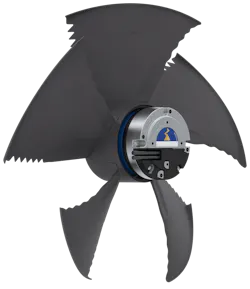
Fan manufacturers are also refining acoustics. Barn owls fly almost silently because the serrated, fringed edges of their wing feathers break up the air turbulence that creates noise. Ziehl-Abegg borrowed that idea for one axial impeller design, adding a serrated trailing edge that disrupts noise patterns as air leaves the blade.
The next generation of facility cooling will not be defined by airflow volume alone. The strongest systems will be those that deliver the right air, at the right speed, through the right path, with enough intelligence to adjust as conditions change. For facility teams, that shifts the retrofit conversation away from a simple equipment swap and toward a more disciplined evaluation of heat load, pressure, distribution, control, and service access.
Persistent heat problems rarely come from one variable. They are usually the result of several conditions working together. A better fan system can help, but only when it is selected as part of a broader understanding of how heat actually moves through the facility. When teams diagnose the problem first and retrofit around the real operating condition, cooling upgrades become more than a reaction to hot spots. They become a way to improve efficiency, reliability, and control across the space.