Nidec Adds Self-Learning Control to LAMDA Metal 3D Printers
Key Highlights
- A coaxial camera measures melt-pool brightness and working distance to guide real-time process adjustments.
- The patent-pending system changes laser power and travel speed as build conditions evolve.
- The system completed a thin-wall build and a build with overlapping toolpaths that open-loop and PID controls did not finish.
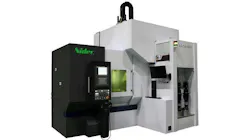
In directed energy deposition (DED), heat builds up as a part grows. Thin walls and spots where toolpaths cross take on more heat than the surrounding material. The melt pool can overheat, and the build can sag or collapse. Fixed process parameters (open-loop control) and conventional proportional-integral-derivative (PID) control often can't keep up as conditions change during a build.
Nidec Machine Tool developed an autonomous learning-based automatic control system for its LAMDA Series metal 3D printers to address that problem. The system learns from conditions during the build and adjusts process parameters as the part takes shape.
How It Works
A coaxial camera measures two things: melt pool brightness, which correlates with temperature, and the working distance between the nozzle and the workpiece. A patent-pending algorithm and patent-pending image processing use those readings to adjust laser power and travel speed in real time.
Operators set only baseline target values. The system doesn't need a large training dataset collected ahead of time. Output limits and other safeguards help manage the uncertainty that comes with machine learning-based control.
Test Results
Nidec compared the system with open-loop and PID control on two maraging steel builds.
Open-loop control is a method in which fabrication continues under predetermined, constant conditions. PID control is a feedback control method that monitors the build process using a camera and automatically adjusts laser power and travel speed.
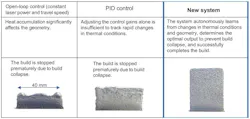
Vertical wall: A single-bead wall 1.6 in. (40 mm) wide and 2 in. (50 mm) tall. The open-loop and PID builds both stopped early when the wall collapsed. The learning-based system completed the build.
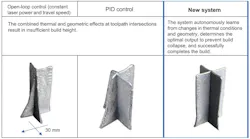
Toolpath intersections: A 1.2 x 1.2 x 2 in. (30 x 30 x 50 mm) build. Open-loop and PID control both fell short of the target height. The learning-based system completed the build, including the areas where multiple passes overlap.
Why It Matters
For shops running DED on metal parts with thin walls or complex toolpaths, a collapsed build means wasted material, lost machine time, and more time spent tuning parameters by trial and error. Because the system adjusts as heat builds, operators don't have to predict how each geometry will behave and set parameters for it ahead of time.
The LAMDA Series uses Nidec's local shielding technology, which lets it build large parts without an inert gas chamber.
Nidec demonstrated the system on the LAMDA500 5-axis printer at JIMTOF2026, which opened Oct. 26 at Tokyo Big Sight. Pricing and availability haven't been announced.
About the Author
Laura Davis
Editor-in-Chief, New Equipment Digest
Laura Davis is the editor in chief of New Equipment Digest (NED), a brand part of the Manufacturing Group at EndeavorB2B. NED covers all products, equipment, solutions, and technology related to the broad scope of manufacturing, from mops and buckets to robots and automation.
Laura has been a manufacturing product writer for nine years, knowledgeable about the ins and outs of the industry, along with what readers are looking for when wanting to learn about the latest products on the market.


kaeser)compr.jpg?h=139&height=139&w=250&width=250)