Peak Nano Expands U.S. Capacitor Film Production 20-Fold
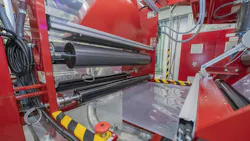
Peak Nano is expanding production of its NanoPlex HDC capacitor film 20-fold at its Macedonia, Ohio, facility. A new Davis-Standard cast film line will move the company's nanolayer dielectric film from early production to full commercial scale, adding up to 3 million lb (1.36 million kg) of annual capacity once it reaches full production in the first quarter of 2028.
"We have breakthrough technology. Now we're building the capacity to let the world see it," said Jim Welsh, CEO of Peak Nano. "Northeast Ohio has been building America's polymer industry for more than a century. Expanding NanoPlex production 20-fold in Macedonia is new growth for Ohio, and it puts American-invented, American-made film at the center of a global market that grids, data centers, and defense systems depend on."
The $20 million investment covers equipment, facilities, and staffing. The new line will produce mono-, multi-, and nanolayered films. It's the first film extrusion line at Roll & Hold, Peak Nano's Macedonia site, and it builds on the Davis-Standard cast nanolayer line the company commissioned in 2022.
According to Davis-Standard, this is its first full-scale production line built for nanolayered films, with applications in dielectrics, medical, and food packaging. "Our teams have worked side by side with Peak Nano since they commissioned the first Davis-Standard line in 2022, and this system takes that work to production scale," said Christian Renners, Davis-Standard's business unit president.
We have breakthrough technology. Now we're building the capacity to let the world see it.
- Jim Welsh, CEO of Peak Nano
A Multipolymer Alternative to Single-Polymer Films
Conventional capacitor films use a single polymer, usually polypropylene, and hit limits on heat, voltage, and service life. NanoPlex layers multiple polymers at the nanoscale. Peak Nano says the film stores more energy, runs cooler, and lasts longer than conventional films. The company designed it as a drop-in replacement, so capacitor manufacturers can qualify it on their existing metallizing and winding equipment without redesigning their products. Peak Nano's applications engineering team supports customers through qualification.
The technology came out of nanolayer polymer research at Case Western Reserve University and was developed with DARPA and the U.S. Naval Research Laboratory. It is covered by more than 20 global patents, and production runs under ISO 9001 certification with in-line inspection and lot traceability.
Domestic Supply for a Tight Market
U.S. production of polypropylene capacitor film ended in 2013, and since then capacitor makers have relied on overseas suppliers. Peak Nano says it's the only U.S. manufacturer of nanolayer dielectric film, engineered and made in the U.S. with materials sourced from allied nations.
The expansion comes as electricity demand climbs. The U.S. Energy Information Administration projects U.S. electricity use will hit a record 4,288 billion kWh in 2026, driven largely by data centers. The Electric Power Research Institute estimates data centers could account for 9% to 17% of U.S. electricity use by 2030, roughly double their current share. Average capacitor lead times reached 19 weeks in October 2025, 46% above pre-pandemic levels, and film capacitors were among the most active categories.
About the Author
Laura Davis
Editor-in-Chief, New Equipment Digest
Laura Davis is the editor in chief of New Equipment Digest (NED), a brand part of the Manufacturing Group at EndeavorB2B. NED covers all products, equipment, solutions, and technology related to the broad scope of manufacturing, from mops and buckets to robots and automation.
Laura has been a manufacturing product writer for nine years, knowledgeable about the ins and outs of the industry, along with what readers are looking for when wanting to learn about the latest products on the market.