How Small Can Manufacturing Go? Inside the World of Nano-Scale 3D Printing
Key Highlights
- The NanoOne printer achieves structures smaller than 200 nm horizontally and 550 nm vertically, surpassing traditional optical microscopy limits.
- 2-photon lithography uses high-intensity laser pulses to trigger localized polymerization, enabling complex 3D nano-structures with high precision.
- Faulhaber's compact DC gearmotors with integrated encoders provide the sub-micrometer motion control necessary for accurate positioning during printing.
- The system can produce a wide range of objects, from microfluidic channels to tiny lenses, with a throughput of over 450 cubic millimeters per hour.
- Applications are primarily in medical technology, pharmaceuticals, and telecommunications, with many projects kept confidential due to proprietary interests.
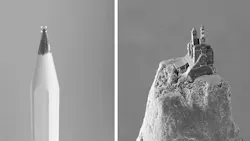
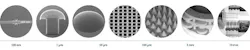
When UpNano printed a model castle on the tip of a pencil—complete with spires, archways, and columns—it wasn't a novelty. It was a proof of concept. The columns measured just 950 nanometers wide. For context, a human hair is roughly 100 times thicker than the bars that make up the printed structures coming out of UpNano's NanoOne 3D printer today.
The technology behind it, 2-photon lithography, allows the NanoOne to produce structures as small as 200 nm horizontally and 550 nm vertically—geometries invisible to both the naked eye and standard optical microscopes. Enabling that level of precision at production throughput requires more than just advanced optics. It requires motion control accurate enough to position the print substrate in the sub-micrometer range. That's where Faulhaber's compact DC gearmotors come in.
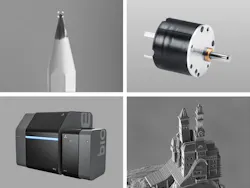
Proof of Concept: A Castle on a Pencil Tip
UpNano is a spin-off of the Vienna University of Technology. Before the founders started their own company more than five years ago, they conducted research at the university in the field of 3D printing with high resolution.

To demonstrate what is possible, they printed the model of a castle complete with multiple levels, oriels, ledges, archways, two spires, and elegant columns—on the tip of a pencil. The columns were just 950 nanometers thick. The printer, which UpNano has since developed to market readiness and sells worldwide, goes even a step further: structures smaller than 200 nanometers can be realized horizontally and smaller than 550 nanometers vertically.
The production of such miniaturized objects is possible thanks to 2-photon lithography, which is based on a quantum effect between two light particles. They thereby trigger the solidification of the material, resulting in the formation of stable chains in the plastic molecules.
"To get the decisive photon pairs across the finish line, we need to fire a massive number of light particles," explains Peter Gruber, co-founder and CTO of UpNano. "This is because we need an enormous photon density with respect to both time and space to bring about the controlled polymerization."
How 2-Photon Lithography Works
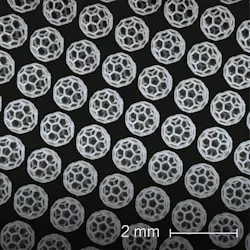
The laser that supplies the photons operates with extremely short, high-intensity pulses. Moreover, the method allows for high accuracy, as Peter Gruber explains, "With other light-based 3D-printing methods, polymerization is triggered along the entire beam path. As a result, production can only be performed in layers. With 2-photon lithography, we can focus them on a tiny point. This point can be moved freely through the material by our printer's high-performance optics. This allows us to produce nearly any geometric structure."
In addition to channels and other elements for microfluidics, such structures can also be used to create lenses that are printed on the end of individual glass fibers. Printing can even take place in existing microfluidic chips to add additional structures there. A special additional module also enables printing with biomaterial, which contains living cells.
Polymerization of the three-dimensional structures transpires only at the intended locations; the cells in the spaces in between remain intact. The constructs can be formed like a cell cluster in human tissue. In such an arrangement, they are used today for pharmaceutical tests without animal experiments.
The Motion Control Behind Sub-Micrometer Precision
The name "Automatic Tilt Correction Insert" describes the function of this support: It corrects the tipping that is nearly impossible to avoid when inserting the print substrate in the printer. The alignment of the substrate can be changed on three axes (x, y, and z) and thereby optimally positioned.
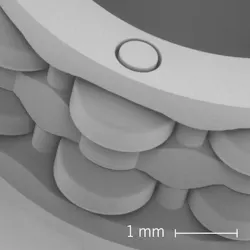
"We achieve a flatness in the sub-micrometer range," emphasizes Peter Gruber. "This ensures that the precision of the laser optics actually finds its way into the print material. Furthermore, the relevant components are decoupled from the surrounding technology and the housing. As a result, the printer can simply stand on any stable table."
The mechanical force for the precise positioning of the support is supplied by three precious metal, commutated DC-gearmotors with integrated encoder of the 1512...SR IE2-8 series from Faulhaber. The uniquely flat winding technology with three flat, self-supporting copper windings enables an extremely compact design with a diameter of 15 millimeters and a length of just 14.3 millimeters. Thanks to the high-performance rare earth magnets, the motor delivers an especially high drive torque.
In addition to the gearhead, an optical encoder is also integrated in the drive. "We selected the gearmotors as the optimum solution for our needs," recalls Peter Gruber. "The suggestion to select the version with the encoder came from Faulhaber. Alignment thereby functions even more precisely and more smoothly. In relation to its small dimensions, the drive delivers enormous power. With its high precision, it contributes to the quality of the printing process of our NanoOne devices at a key point."
Where Nano-Scale Printing Is Being Used
The customers of UpNano are, however, generally reticent to answer the question of exactly what they are producing with the devices. Many use them under strict secrecy. "We are aware of only a few concrete applications, such as in in-vitro fertilization, where work is performed with individual egg cells, or for lenses in micro-endoscopes," reports Peter Gruber. "Our customers are mainly in medical technology, the pharmaceutical industry, and in telecommunication. There are also more and more industries that are discovering the possibilities of miniaturized 3D printing for their own uses."
Editor's Take
Nano-scale 3D printing isn't on most plant managers' radar yet, but the motion control and precision positioning challenges it surfaces are the same ones showing up in advanced automation, semiconductor manufacturing, and medical device production. The big takeaway isn't just how small the structures are, but that production-grade throughput (450 mm³/hr) is already achievable at this resolution. As miniaturization pressure increases across industries, the engineering tradeoffs UpNano and FAULHABER are solving at the nanometer scale today are worth watching.
— Laura Davis, Editor-in-Chief, New Equipment Digest