Warehouse Automation's Biggest Challenge Isn't Technology. It's Orchestration.
Key Highlights
- Integration creates a connected ecosystem where systems communicate seamlessly, providing comprehensive operational context.
- Effective exception management relies on real-time data and intelligent responses to minimize disruption impacts and speed recovery.
- AI, digital twins, and analytics enable predictive insights, allowing warehouses to proactively address issues and optimize performance continuously.
- Successful warehouse orchestration requires expertise across controls, robotics, software, and open architectures working toward shared goals.
- The next phase of automation focuses on holistic operation management rather than isolated asset improvements, ensuring agility and resilience.
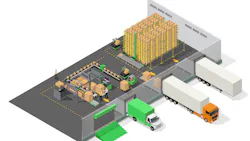

Warehouse operators have spent the last decade investing heavily in automation. Conveyors move products faster. Robotics improve picking and packing efficiency. Warehouse management and execution systems help coordinate increasingly complex fulfillment operations. The result has been significant gains in throughput, productivity, and accuracy.
Yet despite these advances, many facilities continue to struggle with a familiar challenge: when something goes wrong, no single system has the context needed to understand the entire operation.
Today's warehouses are highly automated but often not fully orchestrated. They rely on a network of technologies from multiple suppliers, each generating valuable data but frequently operating within its own silo. This fragmented visibility can make troubleshooting difficult, slow response times, and create operational friction whenever disruptions occur.
As supply chains become more dynamic and customer expectations continue to rise, warehouse leaders are recognizing that future success will require more than just automating individual processes. It will depend on orchestrating entire ecosystems.
The future of warehouse automation can be viewed through three core capabilities: integration, exception management, and optimization.
Integration: Creating a Connected Ecosystem
The first wave of warehouse automation focused on individual assets. Organizations deployed conveyors, automated storage and retrieval systems, robotics, vision systems, and warehouse software to improve specific processes.
While these investments delivered measurable benefits, they also introduced complexity.
A modern fulfillment center may include controls, motion systems, robotics, warehouse execution software, warehouse management systems, ERP platforms, sensors, and maintenance applications. Each system serves an important purpose. The challenge arises when these systems cannot effectively communicate with one another.
Without integration, warehouse operators are often forced to move between multiple screens and applications to understand what is happening across the facility. Data exists, but nothing is connected and the context is missing.
The next generation of warehouse operations will be built on open architectures that allow technologies, regardless of vendor, to exchange information through standardized communication frameworks. Instead of focusing on isolated machines, organizations will focus on connected workflows.
Integration is about more than connectivity. It creates the operational context needed to understand how activity in one area of the warehouse affects performance everywhere else.
For organizations facing increasing pressure to scale, adapt, and improve responsiveness, this connected ecosystem becomes the foundation for more intelligent decision-making.
Exception Management: Responding to Disruption in Real Time
Even the most advanced warehouse encounters disruptions.
A conveyor fails. A robot goes offline. Inventory is unavailable. A labor shortage develops during a peak shift. A sudden spike in demand creates bottlenecks in fulfillment.
These events occur every day across warehouse operations.
The organizations that perform best are not necessarily those that experience the fewest disruptions, but rather, they are the ones that respond most effectively when disruptions occur.
Historically, exception management has been largely reactive. Teams investigate alarms, gather data from multiple systems, identify the source of the problem, and determine corrective actions. Valuable time is lost while operators work to understand what happened and what impact it may have elsewhere in the operation.
As warehouses become increasingly automated, that approach is no longer sustainable.
Connected systems can provide the context needed to manage exceptions more intelligently. Rather than simply reporting that a machine has stopped, an orchestrated operation can help operators understand the downstream consequences, identify alternative workflows, and prioritize responses based on operational impact.
This capability becomes increasingly important as fulfillment networks grow more complex. Customers expect faster delivery, tighter service-level agreements, and greater reliability. Delays that may once have been acceptable can now have immediate business consequences.
Managing exceptions effectively is becoming a competitive advantage. The goal is not to eliminate disruptions altogether. The goal is to minimize their impact and recover faster when they occur.
Optimization: Leveraging AI and Digital Twins
Once systems are connected and organizations have established a more coordinated approach to exception management, the focus shifts to continuous improvement.
Warehouses generate enormous amounts of operational data every day. The challenge is transforming that information into meaningful action.
This is where AI, advanced analytics, and digital twin technologies are beginning to reshape warehouse operations.
Digital twins provide virtual representations of physical operations, enabling organizations to model changes before implementing them in the real world. Warehouse leaders can evaluate equipment layouts, process adjustments, staffing strategies, and operational scenarios without introducing risk to live operations.
At the same time, AI-enabled analytics can identify patterns and relationships that may not be apparent through traditional reporting. Bottlenecks, throughput constraints, equipment degradation, and emerging performance issues can be identified earlier, allowing operators to take action before disruptions impact customers.
The result is a shift from reactive operations to predictive operations.
Instead of asking, "What happened?"
Organizations can begin asking:
- What is likely to happen next?
- How will it affect throughput?
- What actions should be taken now?
- How can future disruptions be prevented?
Optimization is no longer a periodic improvement initiative. It is becoming a continuous process that helps warehouses adapt in real time.
The Future Is Orchestrated
For years, warehouse innovation has focused on automating individual processes. The next phase of the industry's evolution will focus on orchestrating entire operations.
That orchestration requires three foundational capabilities:
Integration: Connecting systems, equipment, software, and people into a unified operational ecosystem.
Exception Management: Responding intelligently and efficiently when disruptions occur.
Optimization: Leveraging AI, analytics, and digital twins to continuously improve performance.
This broader perspective moves the conversation beyond conveyors, robotics, and automation hardware alone. It focuses on the outcome every warehouse operator ultimately cares about: keeping products moving efficiently despite constant disruption.
Few organizations are positioned to address this challenge across the entire operation. It requires expertise spanning controls, motion, robotics, software, digital twins, AI, and open architectures working together toward a shared objective.
The organizations that succeed will not necessarily have the most automation. They will have the most connected, adaptable, and intelligent operations.
Because the future of warehouse automation isn't about individual technologies.
It's about orchestrating them.