NIOSH Funds PPS Tactile Glove to Measure Worker Hand Effort
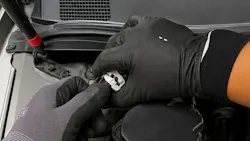
Anyone who has tried to plug in a wiring harness under a dashboard knows how it goes. You can't see what your hands are doing; you're pushing harder than you'd like, and you're listening for a click that may or may not come. Automotive assembly workers do that all shift long. Now PPS (formerly Pressure Profile Systems) has NIOSH funding to measure how hard that job really is on their hands.
The company received a Small Business Innovation Research (SBIR) Phase I grant from the National Institute for Occupational Safety and Health (NIOSH) to build an industrial version of its TactileGlove. The current glove has been used in published ergonomics research to map forces across the hand, but it was designed for labs. The factory version will be simpler and more durable, while also adding inertial measurement units (IMUs) that track hand pose, so the glove records both how hard the hand is pushing and what position it's in.
For now, hand effort in assembly work is judged mostly by watching workers and handing out surveys. Cameras do a decent job until the hands disappear behind a panel or into a door cavity, and even then they can't measure force. Meanwhile, Bureau of Labor Statistics data compiled by the National Safety Council shows overexertion, repetitive motion, and related conditions caused 946,290 U.S. workplace injuries and illnesses across 2023 and 2024 that led to days away from work, job restrictions, or transfers, more than any other type of event.
"Video cameras can capture what a worker is doing. But they cannot accurately measure the effort required or show someone assembling a connector underneath an automotive dashboard," said Jae Son, founder and CEO of PPS. "By combining tactile sensing with motion sensing, researchers can better measure what the hand is doing—even where a camera cannot see."
Researchers at a major U.S. university will run the lab validation on a simulated automotive electrical connector assembly task. It's a fitting test case, since a lot of connectors on a real line are seated entirely by feel, with plant noise drowning out the click. The team will measure how much effort the task takes and figure out which tactile and motion sensors the industrial glove actually needs to capture it reliably. Then they'll add the hand pose data to see how posture affects effort and injury risk.
The connector work could pay off in a second way, too. In vehicle assembly, one connector that isn't fully seated can keep a car from starting, and a glove that can tell a full seat from a partial one could catch the mistake before the car leaves the station. PPS is planning a field study on a working assembly line next, and a major U.S. automaker has already expressed interest.
PPS started developing tactile gloves in 1997 with funding from the Defense Advanced Research Projects Agency (DARPA). That work led to FingerTPS and then the wireless TactileGlove, which is now common in ergonomics, human factors, and robotics research.
"The TactileGlove has been a research tool for many years," Son said. "We are now going beyond the research stage to provide solutions that can help industry today."
The one-year project runs from Sept. 1, 2026, through Aug. 31, 2027, under NIOSH award number 1R43OH012978-01-00. NIOSH/CDC/HHS is funding all $300,748 of it.
About the Author
Laura Davis
Editor-in-Chief, New Equipment Digest
Laura Davis is the editor in chief of New Equipment Digest (NED), a brand part of the Manufacturing Group at EndeavorB2B. NED covers all products, equipment, solutions, and technology related to the broad scope of manufacturing, from mops and buckets to robots and automation.
Laura has been a manufacturing product writer for nine years, knowledgeable about the ins and outs of the industry, along with what readers are looking for when wanting to learn about the latest products on the market.