Sumida, Infineon Develop High-Isolation Medium-Frequency Transformer for Solid-State Transformers
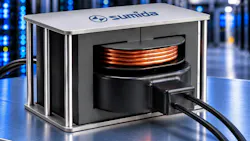
Sumida Corporation has developed a 100-kVA medium-frequency transformer (MFT) for SSTs in collaboration with Infineon Technologies. The transformer runs at a 40 kHz resonant frequency and has an insulation test voltage above 20 kV and a partial discharge extinction voltage (PDEV) above 14 kV.
The transformer meets partial discharge, high-voltage, and basic insulation level (BIL) requirements through air-distance insulation, without potting the primary coil. According to Sumida, if the final design can keep the primary coil unpotted, the transformer will be easier to manufacture and could reach production in a relatively short time.
The company describes the current unit as an initial concept that hasn't been optimized for losses or efficiency yet.
Why SSTs Need a Different Transformer
Conventional transformers run at the grid's 50/60 Hz frequency. They step voltage up or down and keep circuits electrically separated, but they can't control how power flows or connect directly to DC equipment. An SST pairs fast-switching power semiconductors with a medium-frequency transformer, letting it send power in both directions, convert between AC and DC, and actively manage energy moving between the grid and the equipment it serves.
That flexibility matters more as data centers shift to DC power and as facilities add EV fast charging, battery storage, and microgrids. Sumida considers 100 kW near the upper end of what data center applications need. It says only a few projects require more.
100 kVA Medium-Frequency Transformer Specs:
|
|
Higher Frequency, Smaller Transformer
Running at a higher frequency is what lets the transformer shrink. Each AC cycle carries less energy at higher frequency, so the core and copper windings can be much smaller for the same power. It's the same reason modern phone chargers are a fraction of the size of older 60 Hz wall adapters. Because the grid only supplies 50/60 Hz, an SST uses silicon carbide (SiC) semiconductors to convert grid power to high frequency before it reaches the transformer.
Sumida estimates a comparable 40 kHz transformer would measure approximately 13.4 x 10 x 7.3 in. (340 x 255 x 186 mm) and weigh about 51 lb (23 kg). A typical 100-kW, 50 Hz low-voltage transformer weighs 880 to 1,320 lb (400 to 600 kg) and measures about 31.5 x 37.4 x 55.1 in. (800 x 950 x 1,400 mm), according to Sumida. That's roughly 20 times heavier, before adding the extra spacing a medium-voltage unit would need.
The tradeoff is that higher frequency and voltage make insulation, heat, and partial discharge harder to manage. Research prototypes have reached higher insulation ratings. For example, a 166-kW MFT described in a 2024 IEEE Open Journal of Power Electronics paper was tested to 54 kV peak. Sumida's design focuses instead on being simpler to build.
Collaboration With Infineon
Infineon's 3.3 kV CoolSiC devices handle the high-voltage switching in an SST, while the MFT steps the voltage and keeps the input and output circuits electrically separated. The two companies are collaborating on the technical side of SST and MFT development.
Sumida calls the transformer a first step toward power-conversion systems in the 35 kV isolation class. "The journey toward 35 kV continues," said Carl G. LeJambre III, vice president of sales at Sumida.
Sumida is building samples for customers to support functional testing of SST systems in laboratory environments, with a lead time of about six weeks.
About the Author
Laura Davis
Editor-in-Chief, New Equipment Digest
Laura Davis is the editor in chief of New Equipment Digest (NED), a brand part of the Manufacturing Group at EndeavorB2B. NED covers all products, equipment, solutions, and technology related to the broad scope of manufacturing, from mops and buckets to robots and automation.
Laura has been a manufacturing product writer for nine years, knowledgeable about the ins and outs of the industry, along with what readers are looking for when wanting to learn about the latest products on the market.

kaeser)compr.jpg?h=139&height=139&w=250&width=250)