Sonair's ADAR One Becomes First 3D Sensor Certified for Human-Robot Safety
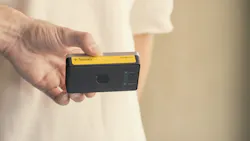
Sonair has received safety certification for its ADAR One 3D ultrasonic sensor, marking the first time a 3D sensor has achieved independent verification for human-robot safety applications—a milestone that could accelerate deployment of autonomous mobile robots in shared workspaces.
The Oslo-based company announced the certification on June 30, clearing ADAR One for SIL 2 (Safety Integrity Level 2) and PL d (Performance Level d) applications. The sensor was assessed under IEC 61496, the standard for electrosensitive protection devices, and also meets IEC 61508 and ISO 13849. Certification was issued by exida, a notified body under the European Machinery Directive 2006/42/EC. The sensor carries a probability of dangerous failure (PFH) below 1.5 x 10⁻⁷ per hour.
This milestone certification is the first time a 3D sensor has been independently verified to meet that bar using sound instead of light—a new sensing modality that complements cameras where they fall short.
- Knut Sandven, CEO of Sonair
The certification addresses a structural gap in how mobile robots currently handle safety. Most AMRs and AGVs rely on 2D LiDAR scanners that detect obstacles only within a single horizontal plane—leaving them blind to people and objects above or below that scan line. ADAR One uses airborne ultrasound and beamforming technology to map a full 180° x 180° field of view with a detection range of 16.4 ft (5 m), capturing a complete 3D profile around the robot regardless of height.
"The bottleneck to safe human-robot coexistence isn't intelligence or speed," said Knut Sandven, CEO of Sonair. "It's safe perception; knowing reliably, under any condition, that a human is nearby."
The sensor is designed to integrate as an independent safety layer beneath existing camera and AI systems, not as a replacement for them. Its compact footprint allows it to be embedded flush into AMR, AGV, and collaborative robot housings—including humanoid platforms—without significant structural redesign.
ADAR One is already in series production and shipping on deployed industrial robots. More than 80 global robotics companies have evaluated the sensor through Sonair's test program since the beta launch a year ago.
"ADAR One does not merely replace a sensor. It introduces a new safety layer for robotics, a certified 3D perceptual foundation that sits beneath any camera, AI stack, or motion system, independently verifying that the space around a robot is safe," said Knut Sandven.
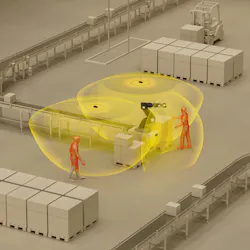
Alongside the certification announcement, Sonair disclosed that palletizing and depalletizing solution provider beRobox has entered into a deployment agreement to integrate the certified ADAR One into future systems—one of industrial automation's more demanding human-robot interaction environments, given the combination of high throughput and close proximity between workers and machines.
The timing aligns with broader industry pressure. According to QNX's 2026 robotics developer benchmark report, 66% of robotics developers experience project delays tied to certification requirements, and only 29% feel confident that physical AI systems can make safe, predictable decisions in real-world conditions. Pre-certified safety components like ADAR One are identified in the report as a key way to reduce both certification timelines and integration risk.
For end users, SIL 2 / PL d certification means ADAR One deployments fit within safety architectures recognized by insurance and liability frameworks—a practical barrier that has slowed adoption of 3D sensing in regulated warehouse and logistics environments.
What Certification Unlocks Across the Industry
The practical impact of that certification depends on where you sit in the automation chain.
For robot OEMs, it removes the most expensive part of deploying 3D safety: the engineering burden of building and validating it from scratch. ADAR One arrives pre-certified to SIL 2 / PL d, which means manufacturers can move to market with 3D-capable safe robots faster and at lower cost than building around 2D LiDAR workarounds.
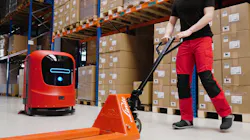
Systems integrators gain simplicity. ADAR One can be dropped into AMR, AGV, and collaborative robot architectures without navigating special exemptions or custom safety case documentation for each deployment. The certification does that work upfront.
For end users, the stakes are more concrete. Robots operating in certified 3D safety architectures qualify under the insurance and liability frameworks that govern industrial workspaces. That changes the risk calculus on deployment decisions that may have stalled over safety compliance concerns. More uptime, fewer incidents, and a defensible paper trail if something does go wrong.
The humanoid angle is worth watching, too. As humanoid robots move from pilots to production floors, their full-body form factor creates detection challenges that 2D scanning simply cannot address. ADAR One's compact size means it can be embedded directly into a humanoid's body shell without structural redesign—providing certified 3D perception where camera-and-AI stacks currently offer none.
ADAR One is available now.
About the Author
Laura Davis
Editor-in-Chief, New Equipment Digest
Laura Davis is the editor in chief of New Equipment Digest (NED), a brand part of the Manufacturing Group at EndeavorB2B. NED covers all products, equipment, solutions, and technology related to the broad scope of manufacturing, from mops and buckets to robots and automation.
Laura has been a manufacturing product writer for nine years, knowledgeable about the ins and outs of the industry, along with what readers are looking for when wanting to learn about the latest products on the market.