LEIBINGER Unveils 2DJET Coding System at Interpack
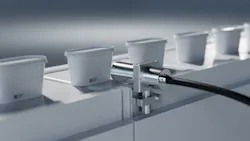
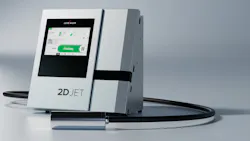
LEIBINGER unveiled its 2DJET coding system at Interpack 2026, introducing what the company describes as a new class of industrial coding developed specifically for GS1 2D code requirements in packaging environments.
The Push Toward GS1 2D Codes
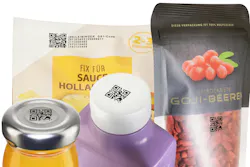
The announcement comes as the packaging industry faces mounting pressure to transition from traditional linear barcodes to GS1 2D codes across food, beverage, pharmaceutical, and FMCG applications. The shift is driven by the ability of 2D codes to carry more data in less space, improve traceability, and meet new compliance requirements, including the EU Digital Product Passport.
One of the challenges driving the transition is that retailers have indicated that pre-printed codes are no longer sufficient—codes must be printed in-line, directly on each product during production, to support real-time tracking of data such as best-before dates.
Existing coding technologies have presented trade-offs in meeting these demands: some deliver the resolution required for 2D codes, while others offer the line speed but fall short on print quality, substrate flexibility, or reliability across diverse production environments. LEIBINGER developed the 2DJET as a direct response to those gaps.
Print Quality and Speed
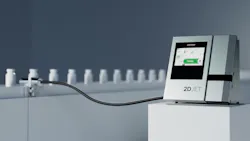
The system prints GS1-compliant 2D codes at up to 300 dpi and speeds up to 394 ft/min (120 m/min), with the capability to print QR codes up to 33 x 33 modules. A throw distance of 0.3 in (8 mm) allows the compact printhead to integrate into existing production lines across a range of packaging geometries, including flat, curved, and challenging surfaces such as flexible films, mono-material pouches, rigid plastics, curved bottles, glass, metal packaging, and non-porous or glossy materials.
Ink System and Substrate Flexibility
The 2DJET uses a continuous ink supply system with precision pumps and sensors to maintain consistent ink delivery during operation. A cartridge-based supply concept uses high-yield XL cartridges that can be swapped during production without stopping the line. Specially developed fast-drying inks support immediate downstream processing at high production speeds.
Maintenance and Total Cost of Ownership
The system requires no filters, is tool-free to operate, and is designed around minimal spare-part demand, with the ink cartridge as the only regular consumable. LEIBINGER says the design supports a total cost of ownership that can return investment within the first year of operation for many applications.
The system is built for 24/7 operation and features an intuitive HMI designed to simplify daily use. A reduced component count and minimal system wear contribute to low maintenance requirements and reduced service complexity.
Availability
The commercial launch is planned for early 2027. Trial and demo installations for pilot projects are scheduled for late 2026.
About the Author
Laura Davis
Editor-in-Chief, New Equipment Digest
Laura Davis is the editor in chief of New Equipment Digest (NED), a brand part of the Manufacturing Group at EndeavorB2B. NED covers all products, equipment, solutions, and technology related to the broad scope of manufacturing, from mops and buckets to robots and automation. Laura has been a manufacturing product writer for eight years, knowledgeable about the ins and outs of the industry, along with what readers are looking for when wanting to learn about the latest products on the market.