Hapman Expands Test Lab for Bulk Material Handling Trials
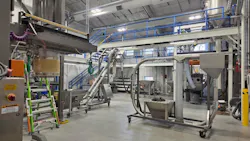
Hapman, a manufacturer of custom bulk material handling equipment, has opened its new, upgraded and expanded test lab that helps processors evaluate how bulk materials will perform in conveying applications. By being able to test how bulk materials will act in specific equipment and system setups, customers can tackle risk possiblities ahead of time by adapting and refining system designs to make sure the equipment will work in their processes before purchasing and installing.
Some of the improvements to the facility include new accomodations for bulk bag unloading and filling, conveyors with higher throughput, and testing for integrated systems that link multiple Hapman technologies and machines together. Engineers can run full production trials including loss-in-weight bulk bag unloading through conveying to gain-in-weight bulk bag filling, using the actual equipment and customers' real materials.
The lab supports testing across three main areas:
Bulk bag unloading:
- Conditioning
- Pinch valve and access chamber options
- Lump breaking
- Screening and rotary airlock discharge
All are mounted on load cells for loss-in-weight control.
Bulk bag filling:
- Adjustable bag height
- Traversing fill heads
- Rear hooks
- Densification features
- Gain-in-weight load cell control
Conveying and feeding:
- Multiple sizes of Helix flexible screw conveyors
- Pneumatic conveyors up to 30 and 36-in e-line units
- CablePro and TubePro tubular drag conveyor configurations
- PosiPortion and PosiPro feeders for controlled, high-accuracy material feeding trials.
Testing across this range lets Hapman compare technologies under identical conditions before making a recommendation.
What's important to note is that this testing lab relies on and encourages customer collaboration. Before any testing, Hapman will review a customer's RFQ data and process requirements, selecting and configuring equipment that matches their needs. Then, the customer's material is brought in to see how it performs with the chosen equipment. If it doesn't do well, Hapman and the customer work on trialing alternatives and documenting the performance for the customer to review. Any design features identified during testing—flow aids, configuration changes and the like—are captured in a test report and carried over into the formal proposal.
For customers already running Hapman equipment, the lab can also be used to evaluate new materials or formulation changes before committing to modifications.
About the Author
Laura Davis
Editor-in-Chief, New Equipment Digest
Laura Davis is the editor in chief of New Equipment Digest (NED), a brand part of the Manufacturing Group at EndeavorB2B. NED covers all products, equipment, solutions, and technology related to the broad scope of manufacturing, from mops and buckets to robots and automation.
Laura has been a manufacturing product writer for nine years, knowledgeable about the ins and outs of the industry, along with what readers are looking for when wanting to learn about the latest products on the market.