Extrusion Tooling Maintenance: How to Clean, Inspect, and Reassemble Your Equipment
Key Highlights
- Set up a dedicated, organized workspace with specialized tools to streamline extrusion tooling maintenance.
- Follow manufacturer guidelines and avoid using damaging tools like steel scrapers to preserve tooling integrity.
- Clean tooling while still hot to effectively remove residues and ensure smooth material flow.
- Inspect all surfaces meticulously for burrs, scratches, and damage before reassembly to maintain precision.
- Reassemble components carefully, adhering to torque specifications and recommended tightening sequences to prevent distortion.
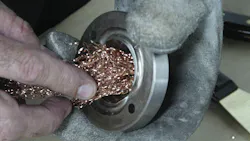
What happens to extrusion tooling between production runs matters as much as what happens during them, and most of the costs that erode extrusion profitability trace directly back to maintenance gaps.
Four cost factors that extrusion maintenance directly addresses:
- Materials often cost more than labor
- Running product oversize to hold minimum tolerance wastes valuable material
- Downtime from poor or damaged tooling is costly
- Keeping an extruder running while it produces scrap is even more costly
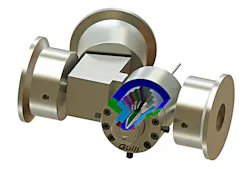
New tips and dies are machined to a determined specification, ensuring concentricity and alignment. Minor misalignment can result in major problems in the final product—including unbalanced flow that introduces stress into the extrudate, causing unpredictable die swell and dimensional inconsistency.
Dirty, neglected, or improperly adjusted tools complicate the die's ability to maintain minimum thickness tolerance, driving up material use and costs that affect profitability and customer relationships.
Set Up a Dedicated Maintenance Work Area
Before any cleaning or disassembly begins, set up a dedicated work cart exclusively reserved for extruder head maintenance. A clean, organized workspace with soft, renewable work surfaces reduces the risk of tool damage and keeps the process efficient.
Your work cart should include:
- A vise with soft metal jaws, such as copper.
- Purpose-built tools such as tip-removal tools.
- Standard tools including wrenches and soft-faced hammers.
- Clean, soft rags.
- Spray bottles of cleaning solutions.
- Spare parts recommended by your tooling supplier, properly organized and stored.
- The repair and maintenance manual provided with your equipment.
- A small surface plate for a true, flat reference surface.
For disassembly, purpose-built tools are essential—these should be available from your tooling supplier. If they are not, consult with a reputable tooling house for replacements.
Store all tools in a dry, clean area with a dedicated spot for each. Surfaces should be soft, and each instrument should be covered after cleaning. Keep tools separated so they do not contact one another, and clean all instruments thoroughly before storage.
Consult Your Operator's Manual
Follow the guidelines in your operator's manual before beginning any maintenance procedure. Individual tools may have specific recommendations, so contact your supplier if anything is unclear. Optimum performance depends on proper care, and suppliers can provide guidance specific to your equipment.
A few general rules apply across most extrusion tooling:
- Never use steel scrapers or screwdrivers as these will scratch and mar tooling surfaces.
- Do not use open flames, which generate excessive heat in thin sections and can affect hardness, concentricity, and tolerances.
- Cleaning ovens may be used for plastic tooling only, not rubber; follow the manufacturer's temperature recommendations and do not exceed 850°F (454°C).
- Never quench tooling to cool it, as this affects hardness, concentricity, and tolerances
- Several purging compounds are available to clear the extruder screw and barrel of residual polymer, which aids considerably in final cleanup.
Clean Your Tooling While It's Still Hot
Clean your equipment while it's still hot since residue is significantly easier to remove at elevated temperatures. In a die, the core tube runs to the back of the head and is adjustable, drawn in and out to control the gum space as material exits the head. Careful cleaning here is critical to ensure smooth flow transition of the material.
Remove and clean one piece of tooling at a time to maintain heat. When cleaning dual-compound crossheads, always clean the plastic tooling first and rubber tooling second.
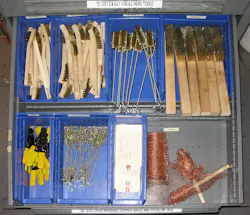
Select the right tools for hot cleaning:
- Brass pliers for gripping and pulling material.
- Brass scrapers in various widths for flat exposed surfaces.
- Brass bristle tube brushes in diameters from 1/16 to 1 inch (1.6 to 25.4 mm), in 1/16 inch increments, for cleaning holes and recesses.
- Brass rods of varying diameters for pushing material out of flow holes.
- Copper gauze for cleaning and polishing exposed round or conical surfaces.
- Copper knives for removing residue from recesses and hard-to-reach areas.
- Polishing compound to restore polished surfaces.
- Compressed air for releasing plastic and aiding rubber removal—take care not to force debris into recesses.
- Cleaning solutions used with fresh, clean rags only; used rags can harbor embedded metal chips that scratch polished surfaces.
Make sure proper lifting equipment is available, including overhead hoists and hydraulic lifts. Properly lined gloves are required when handling tooling at operating temperature. Get assistance when moving heavy parts in awkward positions—surfaces and edges are hard and somewhat brittle, and drops or impacts can cause damage.
Inspect All Surfaces Before Reassembly
Die components—especially those with sealing and locating surfaces—are the control surfaces that ensure product uniformity. Precision-machined alignments can be compromised by contamination measuring only a few thousandths of an inch; a human hair is roughly 0.003 inches (0.076 mm) in diameter. Cleanliness at these surfaces is critical.
Examine all surfaces for burrs, scratches, and scrapes before reassembly. These are typically the result of careless handling or storage and must be repaired before the head goes back together. Use a hand polishing stone to remove burrs, followed by 600-grit emery cloth if necessary. Avoid rounding edges that are meant to be sharp.
For flat sealing surfaces, place 600-grit emery cloth on a clean, flat surface plate and work in a circular hand motion until the surface is clean and even. Components are hardened steel alloys and will not be adversely affected by this process. Inconel, Monel, and Hastelloy are typically not heat-treated and require special care to avoid damage.
Multilayer extrusion heads present a greater maintenance challenge than single-layer heads—the number of sealing and centering surfaces multiplies, and the consequences of dirty or damaged surfaces are magnified. Foreign matter is most commonly introduced during compound or tooling changeovers, and physical damage most often occurs at this stage due to mishandling. These are highly precise parts that can also be heavy and bulky to handle—use mechanical or manual lifting assistance to avoid mishaps.
Reassemble Carefully and Follow Torque Specifications
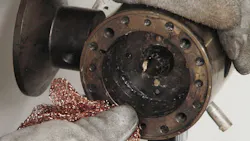
Working from your dedicated tool cart, follow the die manufacturer's reassembly instructions. Give each component a final wipe with a clean rag before installing—even small amounts of grit or residual material must be removed.
Reapply anti-seize compound to all fasteners as required. Tighten fasteners to the manufacturer's specified torque and in the recommended sequence—typically a star pattern, tightening gradually to final torque. This prevents distortion of the tooling.
A properly designed die forms a concentric cone of compound as quickly and accurately as possible at the primary section, where extrudate first emerges from the distribution capillaries. Adjusting the die shifts the extrudate off-center, forming an eccentric cone in the primary area rather than a smooth, continuous flow path with decreasing volume. A properly maintained and aligned extrusion head should require little or no adjustment.