Protal 3200CF and 2800CF Pipe Repair Systems Skip Hot Welding
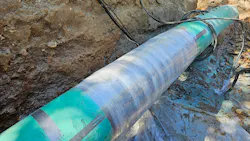
Corroded, wall-loss, and mechanically damaged pipeline sections often require hot welding or line shutdowns to restore structural integrity, adding cost and downtime to repair projects. Denso's Protal 3200CF and Protal 2800CF composite pipe repair systems are non-metallic solutions that reinforce pipelines, process piping, offshore topside piping, oil and gas risers, and pressure vessels affected by corrosion, wall loss, and mechanical damage without hot work. The systems address non-through-wall defects, can be installed on in-service pipelines to reduce downtime, and are designed in accordance with ASME PCC-2 and ISO/TS 24817.
Protal 3200CF combines dry carbon fiber fabric with Protal 3220 Epoxy Saturant, Protal 7200 Corrosion Barrier Epoxy Primer, and Protal 3210 Load Transfer Structural Filler to form a load-bearing composite layer with a tensile strength of 114 ksi and an elasticity modulus of 9.32 Msi.
Protal 3210 fills pits, dents, corrosion cavities, and irregular surfaces so loads transfer from the host pipe into the composite repair, while Protal 7200 is applied beneath the wrap to help protect the repair zone from future corrosion. The carbon fiber fabric is wet-out with Protal 3220 Epoxy Saturant during installation.
Protal 2800CF uses Protal 7300 Corrosion Barrier Epoxy, Protal 3210 Load Transfer Filler, and a pre-impregnated carbon fiber wrap supplied in a nitrogen-filled foil pouch, delivering a tensile strength of 66.1 ksi and an elasticity modulus of 6.93 Msi. The wrap activates when a continuous light water spray is applied, eliminating the need for a separate wet-out table and resin saturation step. Protal 7300 can be applied to wet or sweating surfaces, where it displaces water as the coating is installed.
Both systems require near-white metal surface preparation in accordance with SSPC-SP10/NACE No. 2 and are installed by trained and certified personnel. ILI markers can be incorporated between wrap layers to help identify the repaired area during future in-line inspections.
For above-ground, UV-exposed applications, the cured composite can be topcoated with Archco 15 or Archco 65, and ViscoWrap or Densyl Tape can be added for additional mechanical or environmental protection. Both systems are installable from 50° to 120°F (10° to 48.9°C) and are rated for a maximum operating temperature of 140°F (60°C).
Applications
- Pipeline corrosion and wall-loss repair
- Offshore topside piping and riser repair
- Pressure vessel reinforcement
Industries
- Oil and Gas
- Pipeline and Midstream
- Offshore
Who It's For
- Repairs without hot welding
- In-service repair without shutdown
- Wet or sweating surface conditions
Features:
- Non-metallic, hot-weld-free pipeline repair
- Protal 3200CF: dry carbon fiber fabric wet-out system; tensile strength 114 ksi; elasticity modulus 9.32 Msi
- Protal 2800CF: pre-impregnated carbon fiber wrap, water-spray activation; tensile strength 66.1 ksi; elasticity modulus 6.93 Msi
- Complies with ASME PCC-2 and ISO/TS 24817
- Installable on in-service pipelines
- Installation temperature range: 50° to 120°F (10° to 48.9°C)
- Maximum operating temperature: 140°F (60°C)
- Requires SSPC-SP10/NACE No. 2 near-white metal surface preparation
- Optional ILI markers for in-line inspection identification
- Optional Archco 15 or Archco 65 topcoat for UV-exposed applications
- Optional ViscoWrap or Densyl Tape for added mechanical/environmental protection
Denso, Inc.
Houston, TX
(281) 821-3355
[email protected]
densona.com