Installing a Vertical Reciprocating Conveyor in an Existing Plant: What to Plan For
Key Highlights
- Assess building constraints such as door sizes, aisle widths, and structural details early to facilitate smooth equipment delivery and installation.
- Plan staging areas and work windows carefully to minimize interference with ongoing production and ensure safety during installation.
- Coordinate with facility teams to establish clear communication, safety zones, and routing plans, reducing risks and operational disruptions.
- Evaluate rigging, power routing, and structural support needs beforehand to prevent delays and unexpected costs during installation.
- Provide comprehensive operator training and support post-installation to ensure safe, effective, and sustained use of the VRC.
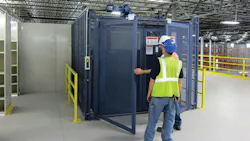
Adding a vertical reciprocating conveyor (VRC), also known as a material lift, to an existing facility is rarely just an equipment installation. In new construction, the VRC is planned as part of the building process, with the surrounding structure, power, access, and trade sequence accounted for before the space is occupied. In an active warehouse, manufacturing plant, or distribution center, those same installation requirements must be worked into a facility that is already moving people, inventory, and production through the building.
This difference in active facilities changes the installation process. The lift still needs to arrive, move through the building, be staged, assembled, aligned, powered, tested, and turned over safely. Every step must account for the facility already operating around the installation. Aisles may need to remain open for production traffic, staging areas may already be committed to inventory, and hot work may require fire watch or other safety controls. Existing conditions can add another layer of complexity when sprinkler lines, conduit, piping, mezzanine details, or structural elements differ from older drawings. Even rigging becomes more difficult when the building was not originally designed with a material lift in mind.
For operations and facilities teams, the best installation outcomes begin before equipment reaches the site. The goal is to understand how the installation will affect production, how production will affect installation, and what must be clarified before small field conditions become schedule problems.
The First Constraint Is the Building You Already Have
In active facilities, the practical installation questions are often more important than the general concept of adding vertical material movement. The team may already know why a VRC is needed: to move materials between levels more safely, reduce forklift travel, provide efficient material access to a mezzanine level, improve throughput, or create a more efficient connection between production, storage, and shipping. The more critical consideration is how the equipment will physically enter and fit into a building that was not originally organized around it.
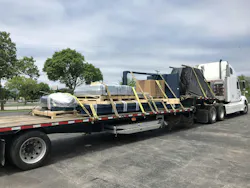
That starts with access. VRCs are commonly shipped by flatbed truck, which means the receiving plan needs to account for unloading, handling equipment, and the route from the delivery point to the installation location. A clear path through the building should be confirmed ahead of time, not assumed from a floor plan. Door dimensions, aisle widths, turning clearances, floor conditions, overhead obstructions, and temporary production constraints can all affect how efficiently equipment gets to the work area.
Staging space is another early issue. Depending on the configuration and site conditions, installation may require a substantial laydown area, sometimes as much as 50 ft by 50 ft (15.2 m by 15.2 m). In a live facility, space is rarely empty. When the laydown area is not planned early, the installation team may lose time reorganizing the site, moving material repeatedly, or working in a space too constrained for efficient assembly.
The installation location itself also needs careful review. Existing drawings may not reflect every pipe, sprinkler line, conduit run, wall condition, or field modification made over the life of the building. A mezzanine may have structural details that differ from the drawings. A wall opening may not align exactly as expected. Power routing to the disconnect for the VRC control panel may involve more coordination than anticipated. These details do not make installation impossible, but they can change the sequence, cost, and timeline if they are discovered after crews arrive.
Rigging, Welding, and Work Windows Shape the Schedule
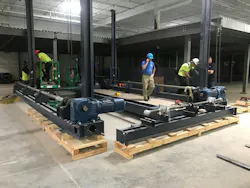
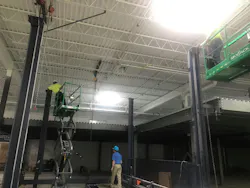
Rigging is often one of the most significant differences between new construction and installation in an active facility. In new construction, teams may have more freedom to use cranes, lifts, temporary access points, or structural provisions that were anticipated during design. In an existing facility, there may be no hoist beam, no convenient rigging point, and limited overhead clearance where the columns, carriage, and drive base need to be positioned.
That is why rigging should be treated as an early planning item rather than a field decision. The team needs to understand how the heaviest components will be moved into place, what rental equipment may be needed, whether the building structure can support the planned approach, and whether additional scope, such as installing a hoist beam, may be required. Without that review, the installation can be delayed by an expensive surprise that was visible in the details but not addressed during planning.
Welding can create another layer of coordination. In an active facility, welding may require fire watch, temporary protection, additional permitting, housekeeping controls, or adjusted work hours, depending on the environment. The question is whether welding can occur safely without exposing employees, inventory, packaging, dust, fumes, or combustible materials to unnecessary risk.
Work windows also affect installation efficiency. A live facility may restrict noisy work, hot work, aisle closures, shutdown periods, lift equipment access, or work near active production. Those restrictions are reasonable, but they change the timeline. Compared with a project in an open construction environment, installation in an operating facility may add one to two weeks, especially when crews must work around production schedules or stop and restart work to avoid interfering with operations.
The most efficient schedule is not always the fastest schedule on paper. It is the one that accounts for the actual operating environment. If production teams know when an aisle will be blocked, when power work is planned, and when the installation area needs to be isolated, they can plan around those windows. If the installation team understands the facility's busiest periods, safety protocols, and access limitations, they can sequence work more realistically.
Safety Depends on Separation, Communication, and Practical Controls
Installing a VRC in a live facility brings two safety concerns together: the normal safety requirements of installation work and the daily safety needs of the facility. Crews may be lifting heavy components, working at elevation, coordinating electrical work, performing hot work, or assembling equipment near employees who are still trying to move product through the building. Even when the installation area is controlled, the surrounding operation may create distractions, traffic conflicts, or pressure to reopen a space too quickly.
The first safety requirement is clear separation. The installation area, laydown space, access path, and any temporary work zones should be communicated to the people who use the building every day. Employees need to know which routes are closed, where equipment will move, and when normal traffic patterns will change. In facilities with forklifts, pallet jacks, pedestrian traffic, and production equipment, temporary routing has to be obvious enough to prevent improvisation.
The second safety requirement is communication between the people who own the space and the people performing the work. Facilities teams understand production pressures, internal safety rules, and building history. Installers should understand the sequence, equipment handling requirements, and hazards associated with the installation itself. When those perspectives are combined early, the project has a better chance of avoiding conflicts between what the crew needs and what the operation can safely allow.
Equipment design can also support safer installation and maintenance. Safe rigging points on heavy components give installers a clearer and more controlled way to lift and position major assemblies. Features such as maintenance pins and carriage securing options can help create safer conditions for certain service and installation tasks when used according to the manufacturer's instructions. Those details do not replace site safety planning, but they can make the work more manageable when the installer's needs have been considered in the design and support process.
Training is also part of the safety handoff. A VRC is intended for material movement only, not people, and operators should understand the posted capacity, gate and interlock functions, routine inspection expectations, and what to do if the unit does not operate as expected. A successful installation does not end when the equipment moves for the first time. It ends when the customer's team understands how the system fits into daily work and how to use it without creating new risks.
A Support Structure Reduces Field Guesswork
Because active facility installations depend so heavily on details, manufacturer support before and after equipment reaches the site can make a meaningful difference. Many installation challenges are not caused by the VRC itself—they come from the interaction between the equipment, the building, the production schedule, and the trades involved. PFlow Industries supports its VRC projects with a dedicated project manager for each order, along with a dealer and installer network for on-site coordination and, where needed, OEM startup involvement for final checks, operator training, and maintenance education.
No two active facilities present the same installation constraints. Some projects are defined by limited staging space; others involve complex rigging, difficult power routing, or a production schedule that allows only narrow work windows. Recognizing which issues are routine and which require special planning—before equipment ships to the field—is what separates a smooth installation from a disruptive one.
Startup Is Where the Project Becomes Part of the Operation
The first week after startup should feel controlled. Operators should know how the VRC is intended to be used, maintenance teams should understand what to inspect, and production leaders should know how the lift changes material flow. The equipment should not feel like a separate project sitting inside the facility. It should begin to function as part of the operation.
For active facilities, that is the real measure of success. The installation should not simply place a VRC in the building. It should protect the work already happening there while creating a safer and more efficient way to move materials between levels. When the planning is detailed enough, the transition from project to production becomes far less disruptive, and the facility gains the vertical movement capacity it needs without losing control of the operation around it.
About the Author
 Ryan Bauhs
Ryan Bauhs
Field Service Manager, PFlow Industries
Ryan Bauhs is a Field Services Manager with PFlow Industries. As the leading VRC manufacturer, PFlow has developed a comprehensive set of preventive maintenance protocols for each of its VRC models. Learn more at pflow.com/our-knowledge-base/.