ACT-ion Opens Cathode Material Pilot Plant in Texas
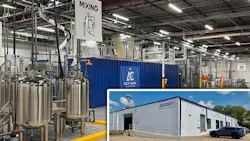
ACT-ion Battery Technologies has opened a pilot plant at 1200 Tappan Circle in Carrollton, Texas, to make cathode active materials (CAM) for lithium-ion batteries in the U.S. The fully commissioned plant uses the company's ACT-ivate process, a continuous manufacturing method that ACT-ion says costs less, has a smaller environmental footprint, and takes less time than traditional CAM production.
"Officially opening our doors today is proof that the vision we shared a year ago is now reality," said Mark McGough, CEO of ACT-ion. "This facility increases our capacity 10 times, to 20 tons per annum, making it the largest all-American phosphate-based CAM producer in the USA."
ACT-ion signed the lease on the Carrollton building in September 2025, so the plant went from signed lease to commissioned production in about 13 months.
Twenty tons a year is still pilot-scale. For comparison, SNE Research reports that global cathode material deployment for EVs reached about 1.51 million tons in the first half of 2026 alone.
Why CAM Matters to Battery Buyers
CAM is the fine black powder that forms a battery's cathode. The cathode largely determines a cell's energy, power, lifespan, and cost. According to the International Energy Agency (IEA), CAM makes up about 50% of cell production costs, depending on chemistry. The IEA also reports that about 85% of the CAM used in electric car batteries in 2025 was produced outside the U.S.
The world isn't short of cathode material. The issue is where it's made. S&P Global Mobility expects worldwide CAM plants to run at only 35% to 45% of capacity through 2030, because slower EV sales have left plants idle, including in China. For U.S. automakers, cell makers, and energy storage developers, a domestic CAM source is about supply chain security rather than trying to fill a shortage.
This facility increases our capacity 10 times, to 20 tons per annum, making it the largest all-American phosphate-based CAM producer in the USA.
- Mark McGough, CEO, ACT-ion.
How the ACT-ivate Process Works
ACT-ivate is a continuous supercritical hydrothermal process that produces coated single-crystal CAM. Supercritical hydrothermal synthesis reacts precursor solutions in water that's been heated and pressurized past its critical point, above 705°F (374°C) and 3,200 psi (22.1 MPa). Under those conditions, cathode crystals form quickly in a continuous flow instead of in long batch steps. The platform, developed with Argonne National Laboratory as Hydro4Crystal, won a 2024 R&D 100 Award in the Process/Prototyping category, according to ACT-ion and a U.S. Department of Energy roundup of AMMTO-funded winners.
"This continuous manufacturing technology seamlessly integrates single crystal formation, lithiation, doping, and surface coating of CAMs into a high-throughput one-pot process that is suited for mass-volume and low-cost production," said Youngho Shin, a senior process development engineer at Argonne.
ACT-ion says the process uses less energy, water, and floor space than conventional methods, produces no harmful byproducts, and delivers higher throughput with a simpler production flow. The company also says single-crystal CAM improves battery performance and extends cycle life. The process accepts lower-cost domestic feedstocks, which ties directly to the plant's cost goals.
"One of the most powerful advantages of our ACT-ivate technology is its unprecedented feedstock flexibility," said Jin Lim, founder and chief technology officer of ACT-ion. "We incorporated lower-cost domestic inputs like industrial-grade chemicals and recycled black mass, allowing us to reduce costs while delivering the high-quality materials the market demands."
One Process, Multiple Chemistries
Many CAM producers are locked into one battery chemistry. ACT-ion has shown the ACT-ivate process works with both lithium iron phosphate (LFP), the lower-cost option, and nickel-cobalt-manganese (NCM), the higher-performance option. That lets the company follow market demand instead of betting on a single chemistry. According to Hunt Energy Enterprises' 2024 award announcement, the platform has also been demonstrated on lithium manganese iron phosphate (LMFP) and cobalt-free lithium- and manganese-rich oxides (LMR). ACT-ion says it's now applying the process to sodium-ion battery materials as well.
Backing From Battery Industry Investors
ACT-ion paid for the Carrollton build-out with an $11.5 million pre-Series A round. The company closed an initial $7.5 million in late 2024, with participation from BASF Venture Capital, Hunt Energy Enterprises, Arosa Capital, Mirae Asset Capital, and LG Technology Ventures. A $4 million extension in September 2025 was led by South Korea's Kyobo Life Insurance Group and KB Investment. At the time, ACT-ion said the money would go toward finishing and commissioning the pilot plant and toward commercial validation and offtake agreements with partners in the EV and energy storage markets.
The U.S. Department of Energy's Advanced Materials & Manufacturing Technologies Office (AMMTO) and Vehicle Technologies Office (VTO) are supporting the pilot plant's scale-up.
About the Author
Laura Davis
Editor-in-Chief, New Equipment Digest
Laura Davis is the editor in chief of New Equipment Digest (NED), a brand part of the Manufacturing Group at EndeavorB2B. NED covers all products, equipment, solutions, and technology related to the broad scope of manufacturing, from mops and buckets to robots and automation.
Laura has been a manufacturing product writer for nine years, knowledgeable about the ins and outs of the industry, along with what readers are looking for when wanting to learn about the latest products on the market.
Related
 Complete, Turnkey, Li-Ion and LiFePO4 Battery Recycling Systems
 Electric car charging station for charging EV battery