TruLaser Weld 3000 Laser Welding Cell Has AI Path Correction
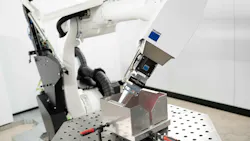
Shops that weld sheet metal assemblies in small batches with many part variants lose production time to reprogramming every time a component changes, and confined floor space limits how much automation they can add. Trumpf's TruLaser Weld 3000 is a compact robotic laser welding cell built for high-mix sheet metal work, with AI-assisted programming, compact welding optics, and a 12 x 12 ft (3.6 x 3.6 m) enclosure footprint.
The cell can be programmed directly at the machine or offline with TruTops Weld software from a separate location, so operators can build new programs while the machine continues running production. Welding programs are generated from CAD data, and the TeachLine Touch function corrects minor deviations by letting operators reposition weld points by tapping the machine screen, which reduces programming and setup time by up to 50% compared to conventional programming. The TeachLine AI feature extension detects deviations in weld points and corrects the robot path to match the actual component configuration, shortening setup for new parts and allowing less experienced employees to run the cell.
Redesigned welding optics are approximately 40% smaller, allowing the robot to reach hard-to-access areas such as the interiors of deep housings, crates, and boxes. This expands the range of parts that can be automated and reduces manual rework.
Several laser welding technologies support process stability and weld quality. BrightLine Scan pairs a high-frequency scanner with motorized focus adjustment to widen the weld seam in fillet and overlap welds, increasing the connecting area and joint strength. BrightLine Weld splits laser power between an inner and outer core in the laser light cable to reduce spatter, particularly during deep welding. FusionLine combines the laser with filler wire for targeted material deposition, bridging gaps up to approximately 0.06 in. (1.5 mm) or welding materials that require filler metal.
The enclosure is about 24% smaller than the smallest version of the TruLaser Weld 5000. A KUKA Iontec robot with an 83 in. (2,100 mm) reach handles pallet-sized components. For part alignment, users can choose a conventional welding table, a tilt-rotate positioner, or a compact rotary changer that allows loading and unloading parallel to production. With 3 kW or 4 kW of laser power, the cell welds stainless steel and structural steel up to 0.31 in. (8 mm) thick and aluminum up to 0.24 in. (6 mm) thick.
Applications
- Sheet metal assembly & housing welding
- Welding inside deep housings, crates & boxes
- Fillet & overlap seam welding
- Gap bridging with filler wire
- Pallet-sized component welding
Industries
- Equipment & plant engineering
- Data centers
- Medical technology
- Commercial kitchen equipment
- Food processing
Who It's For
- High-mix, small-batch production
- Frequent part changeovers
- Limited floor space for automation
- Limited skilled welding labor
- Reducing manual rework on hard-to-reach welds
Features:
- Laser power: 3 kW or 4 kW
- Material thickness: stainless and structural steel up to 0.31 in. (8 mm); aluminum up to 0.24 in. (6 mm)
- Enclosure footprint: 12 x 12 ft (3.6 x 3.6 m), about 24% smaller than the smallest TruLaser Weld 5000
- KUKA Iontec robot with 83 in. (2,100 mm) reach
- Handles pallet-sized components
- Programming at the machine or offline via TruTops Weld software
- CAD-based program generation
- TeachLine Touch weld point correction via touchscreen
- Up to 50% reduction in programming and setup time
- TeachLine AI automatic weld point deviation detection and robot path correction
- Welding optics approximately 40% smaller for access to tight areas
- BrightLine Scan high-frequency scanner with motorized focus adjustment
- BrightLine Weld dual-core power distribution for reduced spatter
- FusionLine filler wire welding for gaps up to approximately 0.06 in. (1.5 mm)
- Part alignment options: welding table, tilt-rotate positioner, or rotary changer
- Loading and unloading parallel to production with rotary changer
Trumpf, Inc.
Farmington, CT
(860) 255-6000
[email protected]
trumpf.com